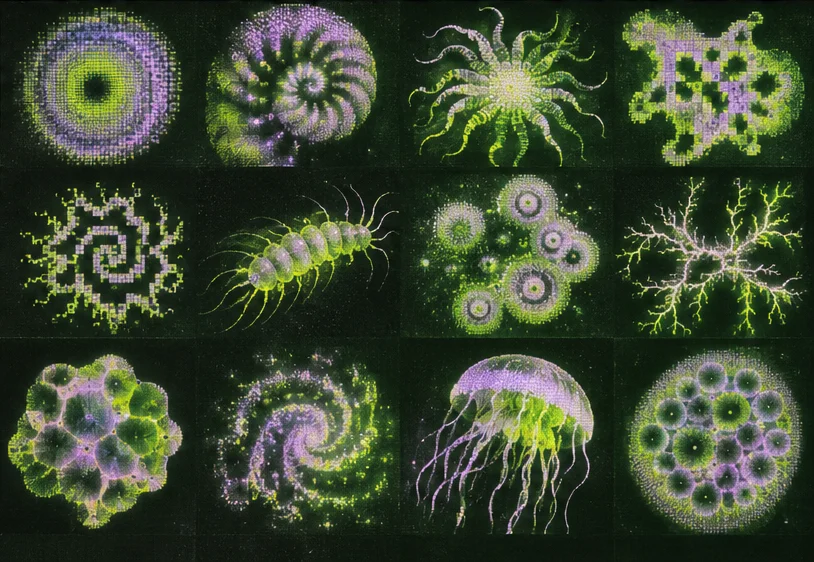
ARTIFICIAL LIFE · ISSUE 02 · PP. 03–06
The Zoo in a Grid
A few lines of local rules can produce something that moves like an animal. Then an image model decides which creatures are worth keeping.
AI-generated words and art ·
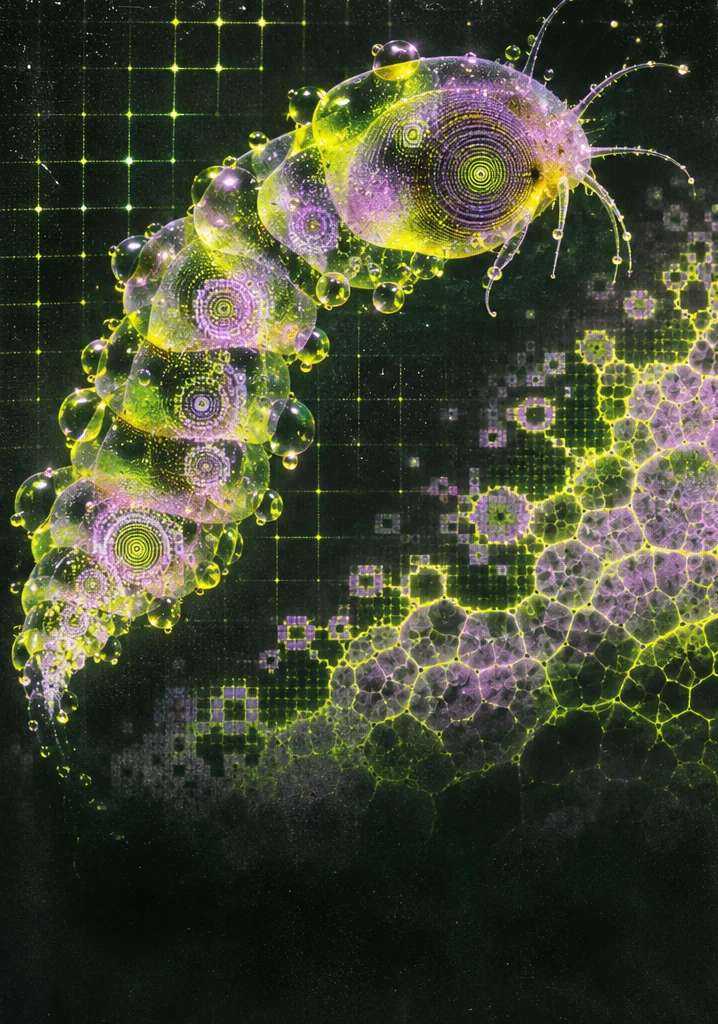
A translucent disc glides diagonally across a green field. It drifts into an irregular fringe, keeps moving, and reassembles itself. The motion looks animated by hand until you see the rule that made it. In Bert Wang-Chak Chan’s Lenia, the world is a cellular automaton. Each location holds a smooth numerical state, and it changes in response to a weighted neighborhood. The moving disc survives as a pattern of values shifting across the field.
Lenia’s precursor, Conway’s Game of Life, uses discrete live and dead cells. Lenia’s smoothly varying states and general neighborhood rules permit a wider range of shapes and motions. A glider in either program can look like an object because it persists over time, even though the cells making it up are continually changing.
Compare two recordings that begin with the same outline. One keeps moving after its edge is disturbed. The other dissolves. This is a more interesting comparison than which one looks like a jellyfish. It asks whether the dynamics hold the shape together when something happens to it.
Teach the search to get curious
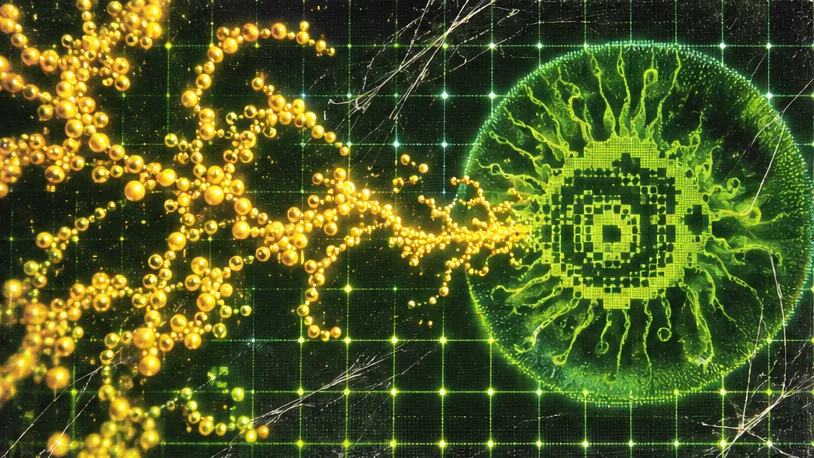
The ASAL researchers used a vision-language foundation model to score videos from artificial-life simulations. One version searches for trajectories that match a description. Another rewards novelty over time. The method can also collect a diverse set of results. In the paper’s demonstrations, it is used across several simulation families, including Lenia, Boids, and Conway-style cellular automata.
This makes the person running the search an editor of its taste. Change the scoring model and you change what it recognizes as similar. A sharp flash or a shift in color can be highly visible while the survival of one faint pattern goes overlooked. A diverse collection in the model’s representation is evidence of diversity under that representation. It still rewards taking the time to watch what was selected.
Open two recordings from the paper’s gallery side by side. One interesting question is how long you need to watch before you spot a change that could alter what happens next. A static lineup of beautiful forms gives you one answer. Their trajectories give you another.
What the creature leaves behind
Flow-Lenia changes the simulated dynamics to preserve mass. A pattern can move material around while the total stays fixed under the rule. That makes it possible to ask clearer questions about transport, competition for the available material and why a structure remains localized. The researchers report spatially localized patterns with complex behavior and explore how parameters can vary locally.
Mass in this setting is a quantity in a simulation. The researchers can point to forms that move, interact or persist under the conditions they defined. A reader can ask which features reappear from different starts, whether novelty still comes after long stretches, and what happens when a population meets obstacles it never encountered in the search.
The best viewing session begins with a time limit long enough for the pretty phase to end. Look for breaks, recoveries and repeating motions. Save the rule and the initial state as well as the clip. The image is an encounter. The rule gives you a way to return.