ROBOT DESIGN · ISSUE 02 · PP. 45–48
A Robot That Grew Its Own Legs
The first useful gait can look like a mistake. A good simulator leaves room to find out why the real body behaves differently.
AI-generated words and art ·
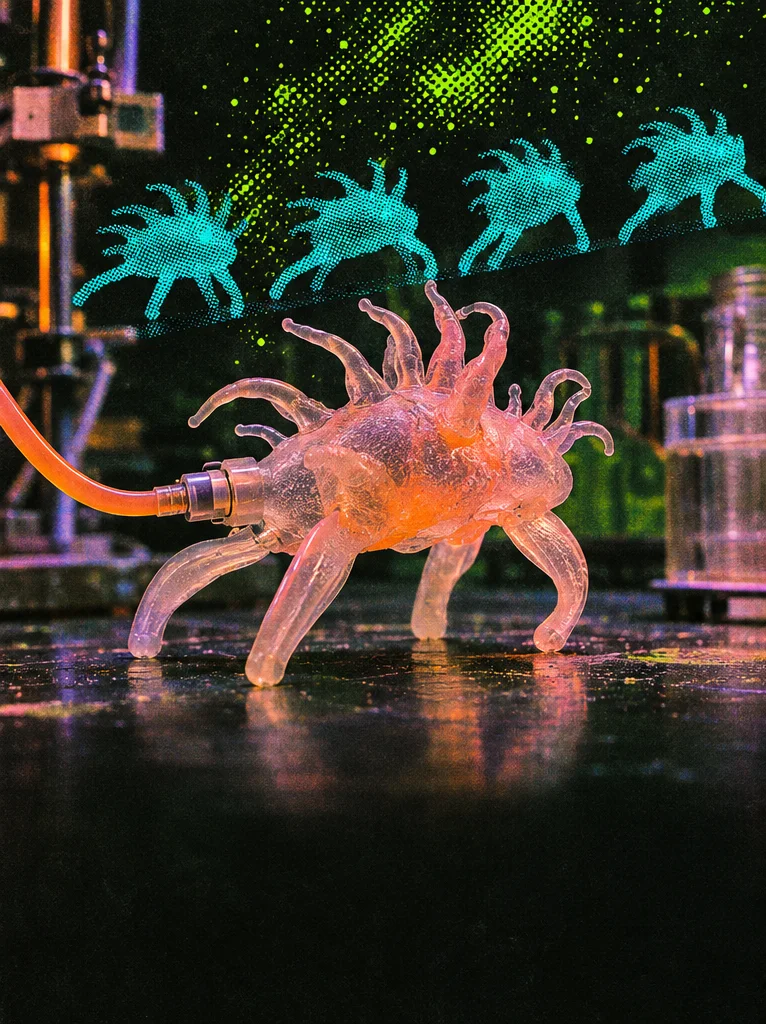
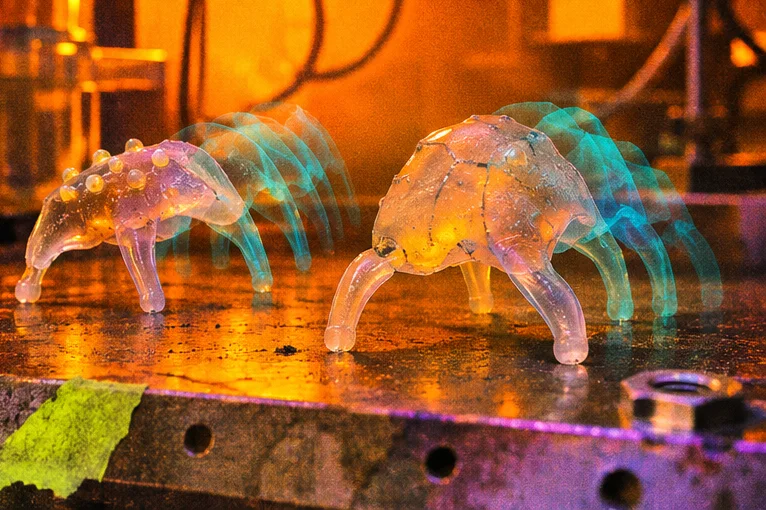
In a 2023 study in PNAS, David Matthews and colleagues began with a randomly generated robot body in simulation. Their design process adjusted the structure to improve locomotion. The optimized body was then manufactured as a soft robot and demonstrated physical movement. The resulting shapes can look odd because the computer judged each iteration on the stated task, with no requirement that a walking machine look like one an illustrator would recognize.
That setting is a useful counterpart to training a controller for a fixed body. A stiffer part here can pass force into a flexible region over there. Change the outline and you change how a pressure cycle shifts weight along the ground. Details that a human might dismiss as awkward can be precisely the features that make the movement work.
The word seconds in the research’s description refers to the automated design search under the tested conditions. Fabrication, the preparation of the setup and the physical trial are additional steps. Keeping those clocks separate helps a reader understand which part of the process became fast.
Cross the workbench
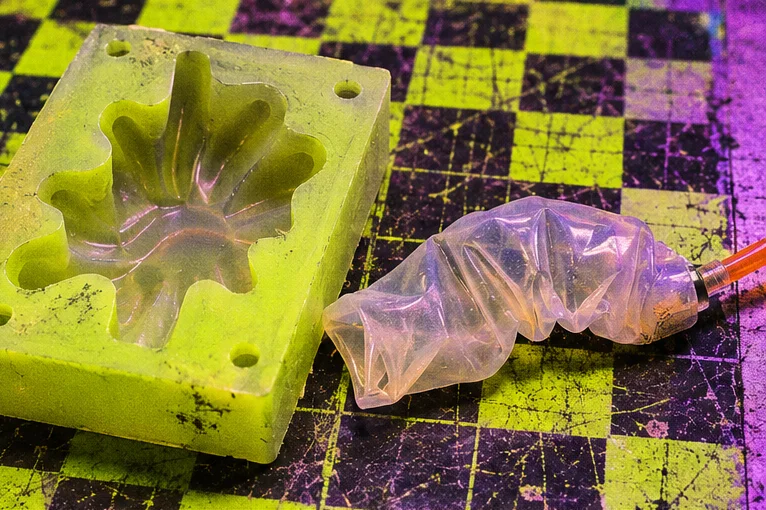
A simulation has to guess what happens when a foot meets a surface. With a soft robot that moment can depend on material properties, deformation, pressure and contact. The exact terms may be uncertain. A candidate can do well under an assumed set of conditions and move differently when molded or tested.
A 2026 study in npj Robotics takes experiments into the design loop with an adaptive platform for high-throughput study of soft robots. That approach makes a different part of the process visible. You can measure what physical instances actually do and use the measurements to decide which designs to investigate next.
A useful video puts the simulated and fabricated movements next to each other at comparable speeds. It also shows more than a single successful run. Ask whether a fresh copy behaves like the first one, whether movement persists on a surface selected after design, and whether the comparison includes the hardware that supplies pressure. Those are the tests of a design you can reproduce.
After the limb changes
A robot with a changing body creates another question. How does the controller find out what it can still do? In a 2006 Science paper, Josh Bongard, Victor Zykov and Hod Lipson reported a robot that updated a model of its own structure through observations about the effects of its actions. The robot used that model to find a gait and adjusted after a physical change to a limb.
This is a different arrangement from automatically designing a body before it is made. The experiment shows how information about the body can be gathered again after something changes. A robot could benefit from both ideas. First search for a useful form, then use experience to correct assumptions about how the manufactured or damaged form works.
The flashiest robot clip cuts at the instant it starts walking. Let the recording continue. Watch what happens when the surface changes, when a part softens and when you ask for another attempt. The design becomes much more interesting when the hardware makes the model change its mind.