COMPUTATIONAL ARCHAEOLOGY · ISSUE 02 · PP. 37–40
A Library You Can’t Open
A student sees a letter in a carbonized roll. Behind that letter is a chain of judgments about X-rays, geometry, ink and Greek.
AI-generated words and art ·
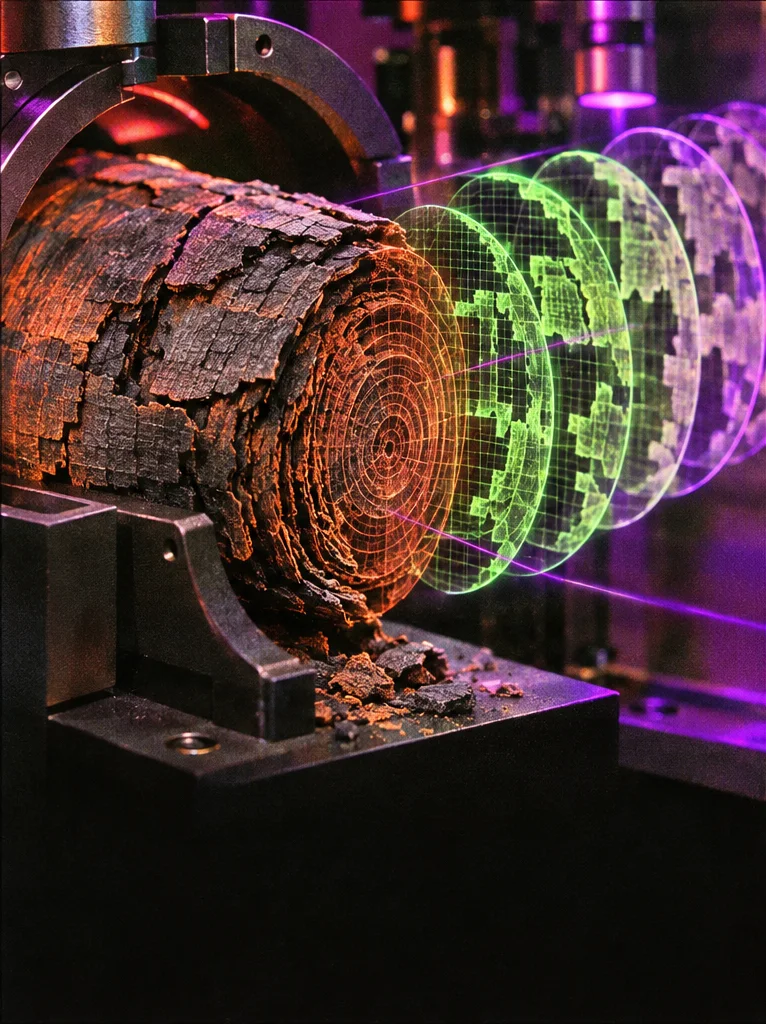
From the outside, a burned papyrus roll can look like a stick that would collapse if you squeezed it. The instrument used on the Herculaneum scrolls records a volume of the object with X-rays. In a good cross-section, compressed layers of the sheet are distinguishable. The task is to follow the correct layer through the roll, which may have been crushed, torn or pressed into its neighbors.
Virtual unwrapping applies a geometry pipeline to that volume. Researchers locate a sheet, represent its surface and flatten part of it into a view a reader can use. A historical precedent is the En-Gedi scroll, digitally unwrapped in a 2016 Science Advances study. Different materials and kinds of ink create different contrast, so the procedure that succeeds for one manuscript may need substantial changes for another.
Consider winding a thin strip around a pencil and then crushing the pencil into an oval. Part of the strip will touch itself. A model tracing the wrong face can produce something that looks continuous across that contact while cutting between two pages. The output should let archaeologists go back through the geometry and ask which layer supplied a given letter.
Where the trained model comes in
In parts of the Herculaneum collection, carbon-rich ink is difficult to distinguish from carbonized papyrus. An ink detector can look for subtle differences in the local scan data. Train it on areas where people have identified ink, predict on a new area, and then check whether the emerging marks line up with the sheet and form plausible character strokes.
The Vesuvius Challenge’s 2023 grand prize announcement documents the recovery of text from an intact roll using machine learning and virtual unwrapping. The competition made the problem legible to people with very different skills. One participant could improve the surface. Another could improve the ink prediction. Papyrologists could then inspect the output and ask for a better rendering of a particular passage.
A good ink map makes uncertainty visible. A faint stroke near a crack is a different proposition from a continuous line of securely placed characters. Save the scan, surface and ink prediction as separate things. A human who sees the context can return to the measured volume when a reading would change a name or make a sentence unusually convenient.
A complete surface has an edge
A 2026 preprint by Giorgio Angelotti and colleagues reports the complete digital unwrapping and reading of the preserved writing surface of PHerc. 1667, a remnant of an earlier attempt at physical opening. The manuscript is a careful example of how conservation, synchrotron scanning, geometry and scholarly interpretation can form one workflow.
The word preserved matters. A recovered surface still has an edge, tears and damaged parts. If a passage survived only in part, virtual unwrapping can make the surviving evidence accessible. The transcription can distinguish a visible character from a probable reconstruction and leave space for a word that remains unsettled.
The endangered material gives this machine-learning result an unusual public test. The point of a better model is a reading that another scholar can investigate. A new line of Greek should lead to its place in the roll, its image, and the decisions a reader made about it. An otherwise beautiful result is much less useful if it breaks that chain.