BIOHYBRID COMPUTING · ISSUE 01 · PP. 21–24
The Arcade in the Petri Dish
Neurons played a role in a game of Pong. The interesting part was everything that had to happen around the dish.
AI-generated words and art ·

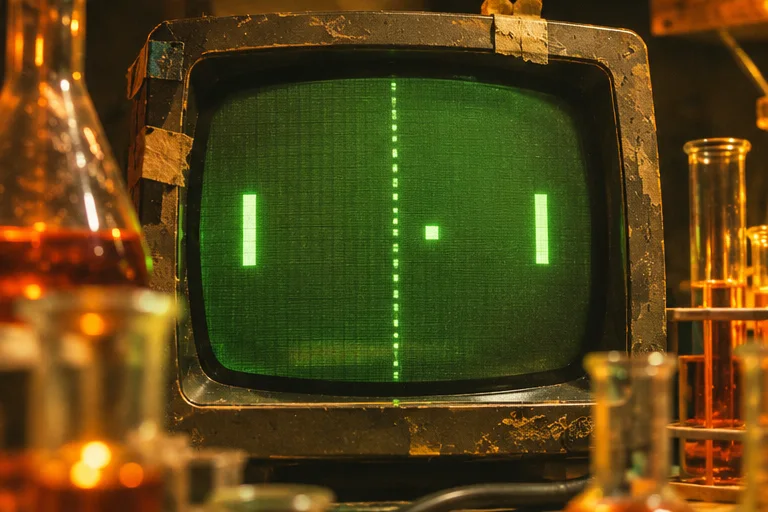
In the DishBrain experiments reported in Neuron in 2022, living neuronal cultures were coupled to a simplified Pong environment. Electronics conveyed information about the ball, and recorded activity was translated into paddle motion. Changes in play then changed which signals the cells received. That closed loop is the experiment. A dish full of active neurons by itself has no game to play.
The authors reported evidence of performance changes under particular feedback conditions. The setup used dissociated cultures. Later organoid computing experiments used three-dimensional tissue. Both fields borrow machinery from neuroscience, yet their claims deserve to be read at the scale of the actual test. Pong has a constrained environment, a small action space and a convenient measure of whether a ball was intercepted.
A fair comparison starts with simpler players. What would a random paddle do? What would you get if the system replayed its old inputs without responding to the ball’s new state? The answers help locate the contribution of the closed loop before we ascribe larger capacities to the culture.
A material with memory
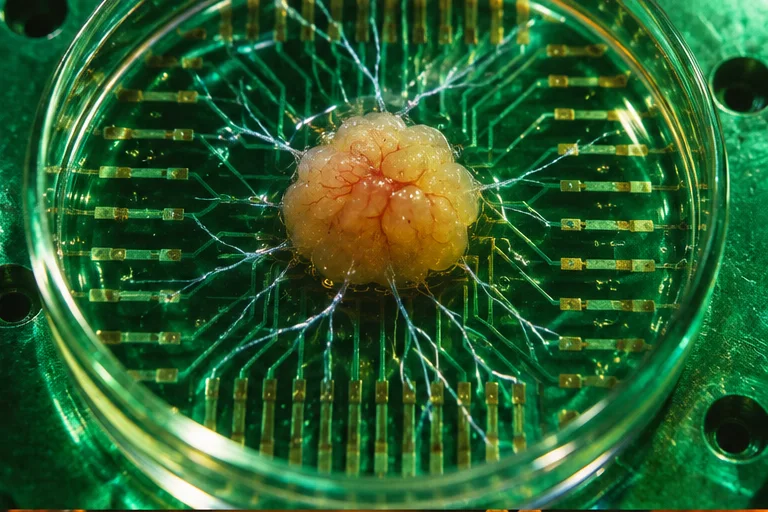
Brainoware, reported by Hongwei Cai and colleagues in Nature Electronics in 2023, treated a brain organoid as part of a reservoir computer. A reservoir is a system with complicated internal dynamics. When it is driven with changing inputs, its present response can carry traces of previous inputs. Software can learn to read that response for a particular task.
A cheap conceptual model is a vibrating surface. Two taps in quick succession leave a different pattern from two taps separated by a long pause. Reading the surface at the right moment gives you a clue about what happened earlier. An organoid’s activity is far more complicated than that surface. The analogy explains why a useful transformation can come from the material’s dynamics rather than a list of explicitly programmed instructions.
The Brainoware paper reported experiments in speech-related classification and nonlinear prediction. Keep track of the whole system: an input encoding, a living component, recording equipment and a trained readout. An image of the tissue alone leaves most of the computation out of frame.
When living hardware leaves the bench
A September 2026 Brainobot preprint by some of the same researchers describes a proof of concept that puts organoid computing into a higher-level robot control loop. The authors report object grasping and laser-following demonstrations. Treat them as early experimental results. A reader comparing them with an ordinary robot controller should ask which decisions went through the living component and which parts the conventional controller handled.
Living hardware brings a maintenance problem into the computing stack. Hardware performance includes the supporting equipment and how long the signal remains usable. Energy claims also depend on where the measurement stops. A comparison limited to activity in the living material tells a different story from one that counts the full apparatus.
There is a parallel obligation to name the ethical question precisely. Donor consent, biological sourcing and the oversight appropriate to increasingly complex cultures all deserve attention. A narrow behavioral result cannot settle subjective experience. What makes this line of research genuinely strange is visible already. We can put a biological process inside an engineered feedback loop and ask what useful signal comes back.